The Association of Professional Genealogists Northland Chapter is sponsoring a “Ask a Genealogist” panel session this Saturday, April 28th at Inver Hills Community College in Inver Grove Heights, Minnesota. IGH is a suburb of St. Paul.
This session will be held from 12:00 - 12:30 p.m. and is open to all conference registrants. Each registrant will receive Ask a Genealogist forms in their registration packet. APG Northland Chapter members David Suddarth, Joanne Sher, and Sandy Thalmann will be there to answer your family history questions.
The session is part of the Central & Eastern European Genealogy Conference being held Friday evening and all day Saturday. For more information on the event check the Minnesota Genealogical Society website at www.mngs.org.
The conference features three sessions by John Philip Colletta, Ph.D. plus 15 breakout sessions in 5 ethnic tracks.
For more information on the Northland Chapter please visit our page on the Association of Professional Genealogists website: http://www.apgen.org/chapters/northland/index.html
26 April 2012

24 April 2012
Jimmy B. Parker SLIG Scholarship
The Utah Genealogical Association has announced a new scholarship program. for its annual Salt Lake Institute of Genealogy. It is named in honor of the late Jimmy B. Parker who was an avid genealogist, former Director of the Family History Library, and a great friend to all who knew him.
The Salt Lake Institute of Genealogy is pleased to announce we are now accepting essays for the Jimmy B. Parker Salt Lake Institute of Genealogy scholarship. Full tuition to SLIG 2013 will be awarded to the student whose essay and application exemplify the culture of giving back lived by Jimmy B. Parker. The scholarship will be awarded by a committee comprised of SLIG committee members and the family of the late Jimmy B. Parker.
Applicants are asked to submit the following via email to sligdirector@ugagenealogy.org:
The Salt Lake Institute runs from January 14-18, 2013 and the winning student will have their choice of the following tracks:
The Salt Lake Institute of Genealogy is pleased to announce we are now accepting essays for the Jimmy B. Parker Salt Lake Institute of Genealogy scholarship. Full tuition to SLIG 2013 will be awarded to the student whose essay and application exemplify the culture of giving back lived by Jimmy B. Parker. The scholarship will be awarded by a committee comprised of SLIG committee members and the family of the late Jimmy B. Parker.
Applicants are asked to submit the following via email to sligdirector@ugagenealogy.org:
- A one-page essay detailing how attending SLIG will help you prepare to give back to the genealogical community, following Jimmy B. Parker’s example.
- A short biography including previous volunteer and research experience.
- The name of the course you would like to attend.
- A letter of recommendation from a someone who has benefited from your volunteer service.
The Salt Lake Institute runs from January 14-18, 2013 and the winning student will have their choice of the following tracks:
- American Research and Records: Focus on Localities (with Paula Stuart-Warren, CG, FUGA, FMGS)
- Bridging the 1780-1830 Gap: From New England to the Midwest (and Points in Between) (with D. Joshua Taylor, MA, MLS)
- Researching Your English Ancestors: Beyond the Parish Register (with Apryl Cox, AG)
- Advanced German Research (with F. Warren Bittner, CG)
- Researching in Washington D.C. without Leaving Home (with Richard G. Sayre, CG, and Pamela, Boyer Sayre, CG, CGL)
- A Genealogist’s Guide to the Internet Galaxy (with Thomas MacEntee)
- Principles of Forensic Genealogy (with Melinde Lutz Byrne, CG, FASG and in partnership with Boston University)
- Producing a Quality Family Narrative (with John Philip Colletta, Ph.D..
- Advanced Genealogical Methods (with Thomas W. Jones, Ph.D., CG, CGL, FASG, FUGA, FNGS)
- Advanced Evidence Analysis Practicum (with Angela McGhie and Kimberly Powell)
- Problem Solving (with Judith Hansen, MLS, AG)
19 April 2012
Minnesota genealogy webinar
I just did a run-through of my Minnesota Genealogy Crash Course for Family Tree University. I will be presenting it live next Wednesday, April 25th at 7:00 pm here in the Midwest. That will be at 8:00 Eastern, 6:00 Mountain, and 5:00 Pacific.
Diane Haddad at the Genealogy Insider just posted some teasers about the presentation. Click here to read that and for the link to sign up for the class.
Diane Haddad at the Genealogy Insider just posted some teasers about the presentation. Click here to read that and for the link to sign up for the class.
16 April 2012
Minnesota genealogy webinar April 25th
 On Wednesday, April 25th, I will be presenting a webinar on Minnesota genealogy. It's part of Family Tree University. I have been researching, writing, and teaching about Minnesota genealogical research for more years than I am willing to admit.
Join me on your computer for the webinar next Wednesday. Visit the Family Tree University website to see a bit more about this Minnesota Genealogy Crash Course and to sign up. The early bird price is only $39.00. Listening live also comes with the opportunity to ask questions.
The webinar is at 8:00 pm. EDT, 7:00 CDT, 6:00 MDT, and 5:00 PDT.
11 April 2012
FGS seeks website administrator
The Federation of Genealogical Societies (FGS) seeks an experienced Website Administrator to maintain its current web presence and assist with the transition to a new web platform during the coming months. This is a paid position.
Responsibilities
The duties and responsibilities of the Web Administrator are to:
- Create, maintain and support all components of the current FGS website hosted at Tiger Technologies and using the FGS domain http://www.fgs.org. This includes the 2012 FGS Conference website component at http://www.fgs.org/2012conference.
- Maintain backup copies of data for the purpose of data recovery and re-creating the FGS web presence if necessary due to data loss or disaster.
- Write and maintain HTML, PHP and MySQL code necessary to maintain a stable web presence for FGS.
- Track all website changes using accepted change control and tracking methodologies.
- Update and create website documentation as needed and to ensure successful transition to future web administrators.
- Create and generate reports as needed and as requested by various FGS committee chairs.
- Maintain the Records Preservation and Access Blog (http://www.fgs.org/rpac) and assist RPAC members with blog posts and technical issues.
- Assist with transition from current PHP/MySQL platform to the Easy Net Sites platform (http://www.easynetsites.com) during 2012.
Qualifications
- Previous experience creating and managing websites. Experience with non-profit organizations preferred.
- Comprehensive knowledge of HTML, PHP and MySQL. Ability to generate reports via MySQL as
07 April 2012
Mount Sterling, Iowa on the 1940 but disbanding in 2012
I just viewed all 4 pages of the Mount Sterling, Van Buren County, Iowa 1940 census. Not a huge town then and today it only has 44 residents. It's in Southeastern Iowa on the Missouri border.
I read an article in today's St. Paul Pioneer Press about the town disbanding. The Associated Press article even says that it has never been a big town. Still, it has been home to generations of people. The article said "Looking back on their town's history, people say the biggest event was in 2003, when then-Mayor Jo Hamlett suggested at a city budget meeting that they could raise plenty of money by adopting a local ordinance to fine people for lying. Although he was joking, Hamlett put the idea in a monthly column he wrote for an area newspaper, and from there it was picked up by other news outlets and soon became an international story."
So sad when towns go away. Many ended up as ghost towns in past years as mines ran dry, after disasters, and especially when railroads, state highways, and later interstate highways bypassed them.
Take a look at the Mt. Sterling Town 1940 census in Vernon Township, Van Buren County, Iowa, Enumeration District 89-23. It's only four pages long. I'm willing to bet that the 1940 enumerator, 20 year old Vinton Rankin [James Vinton Rankin], did not foresee the loss of this town. Nor did his parents Paul and Gail (Helen Gale/Gail Gordon) Rankin.
04 April 2012
Figuring out what's in a record and what to do next
 It's really not that tough a task. I recently wrote an article about this for findmypast.com titled Analyzing Records for Family History.
It's full of practical tips. The website also has other helpful articles.
Click here to read what I wrote on the findmypast.com website.
Watch the website for some great resources that will be on there soon!
03 April 2012
Central and Eastern European Genealogy Conference April 27 and 28 in Minnesota
I received this information from the Minnesota Genealogical Society today:
 Conference events begin Friday April 27 with an evening dessert social and lecture by Colletta, “Finding the REAL Stories of Your Immigrant Ancestors.” Saturday April 28 will be a full-day conference with two more lectures by Colletta and five tracks of breakout presentations focusing on German, Czech and Slovak, Polish, Romanian, and general genealogy topics, including maps and DNA research.
Minnesota Genealogical Society 2012 Central and Eastern European Genealogy Conference
South St. Paul, MN. The Minnesota Genealogical Society (MGS), with co-sponsorship from the Czechoslovak Genealogical Society International, the Germanic Genealogy Society, the Polish Genealogical Society of Minnesota, the Pommern Regional Group of Minnesota, and the Romanian Genealogy Society, will present its Central and Eastern European Genealogy Conference April 27 and 28 at Inver Hills Community College, Inver Grove Heights, Minnesota.
The conference will feature keynote presentations by nationally known genealogical speaker John Philip Colletta, Ph.D., as well as 15 breakout sessions from Upper Midwest genealogical speakers and educators.
Conference events begin Friday April 27 with an evening dessert social and lecture by Colletta, “Finding the REAL Stories of Your Immigrant Ancestors.” Saturday April 28 will be a full-day conference with two more lectures by Colletta and five tracks of breakout presentations focusing on German, Czech and Slovak, Polish, Romanian, and general genealogy topics, including maps and DNA research. The Northland Chapter of the Association of Professional Genealogists will facilitate an "Ask the Genealogists" Q&A session during lunch on Saturday.
More details can be found at www.mngs.org. Conference registration is open at http://www.mngs.org/blog/?page_id=97&action=register&event_id=16.
About the Minnesota Genealogical Society (MGS)
The Minnesota Genealogical Society (MGS) was organized in 1969 to help Minnesotans and people with Minnesota connections research and discover their family history. MGS collects and publishes genealogical, biographical, and historical material, offers educational classes and conferences to support interest in family history, and promotes family history and genealogy as a rewarding hobby and area of lifelong learning.
02 April 2012
Media, hype, and the 1940 census
During the last couple of weeks network television, cable TV, AM, FM, and public radio stations, newspapers, websites, blogs, Twitter, Facebook, Google+ and other forms of media have talked about today's opening of the 1940 census population schedule. The news has been covered at the local, state, and national level. I have seen some international reports too. They have interviewed the "man on the street," family history researchers in libraries and historical societies, librarians, archivists, historians, and professional genealogists.
The media coverage worked. The U.S. National Archives reported a while ago that "Since 9 a.m., we've had 37 million hits to the 1940 Census site."
Might we have a slim hope that the media will see the audience is there and continue to help us by:
The media coverage worked. The U.S. National Archives reported a while ago that "Since 9 a.m., we've had 37 million hits to the 1940 Census site."
Might we have a slim hope that the media will see the audience is there and continue to help us by:
- sharing the news about genealogy educational events BEFORE they take place so people can actually be informed and make plans to attend
- promote the importance of databases (like the Social Security Death Master File aka SSDI) and help encourage legislators to keep the access open
- promote the need for funding for our historical and archival instutions so that hours and staffing levels may be restored.
- promote the need for funding to preserve records all across the U.S.
- tell readers and listeners about the efforts to index, preserve, and share records that are undertaken by genealogical societies and their fantastic volunteers
- tell readers and listeners where to find more help in using the 1940 census and other records
1940 Census: non-resident form
One form that is part of the 1940 U.S. census the whole world seems to be trying to access today is the Non-Resident Schedule. This is for enumerating people where they were on the day the census taker visited, but who said that wasn't their usual place of residence. An example of this form is found for Alturas, Modoc County, California on Ancestry.com: http://bit.ly/H50Ssm. The people are enumerated in in Alturas, Enumeration District 25-4, but state that they live in Delmorma School District in Modoc County, E.D. 25-7. This was found at the end of E.D. 25-7.
The enumerator instructions on the National Archives website shows this for this non-resident schedule:
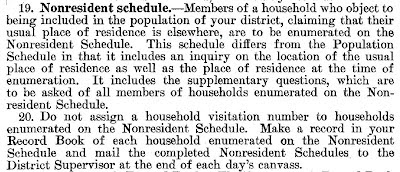
Thank you to Cyndi Ingle Howells of Cyndislist.com for pointing this form out to me.
The enumerator instructions on the National Archives website shows this for this non-resident schedule:
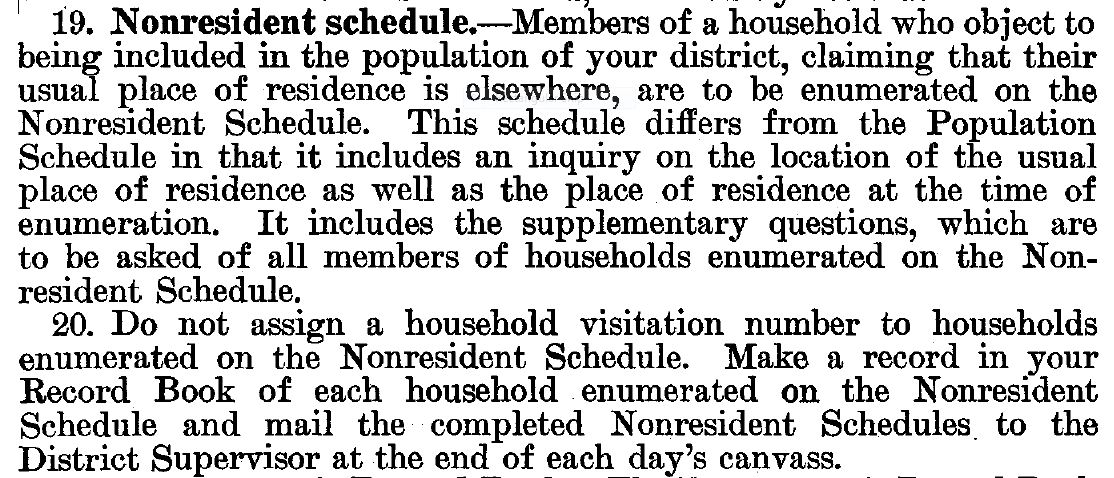
Thank you to Cyndi Ingle Howells of Cyndislist.com for pointing this form out to me.
29 March 2012
Chicago city directories
Chicago's Newberry Library has a blog post that discusses the gaps and the ending of Chicago directories that I referenced in my own blog post yesterday about the 1940 census.
To read the full Newberry post click here.
“Where are the rest of the city directories?” is a question heard frequently at the reference desk. Although the Newberry has a complete collection of Chicago City Directories, there are no directories in the microfilm drawer (or online) for 1918-1922 or from 1924-1928.
To read the full Newberry post click here.
28 March 2012
Finding addresses for the 1940 census search
I recently posted on Facebook that I am working on my family addresses in preparation for the 1940 census opening next week. A couple people sent me private messages asking how I was doing that. So, here are some tips.
For example it showed me that the St. Paul, Minnesota address where my paternal grandparents lived (Stuart, 2019 Princeton) is in E.D. 90-245. I don't have to look through the entire city of St. Paul to find them. I have it narrowed down to a segment of pages. My maternal grandaunts lived at 358 Marshall Avenue in St. Paul and they are in ED 90-131, or 133. My 14 year old mother is probably at 486 So. Hamline Avenue which is an apartment in ED 90-80. For those of you who know St. Paul, these apartments are above the Nook and across the street from Cretin High School (today Cretin-Derham Hall).
And those actual census searches can be done starting Monday, April 2d at several sites, including http://www.archives.gov/research/census/1940/
- Did your family live in a city or town that published annual city directories? Don't know? Check the collections at a large city or county public library for these. The county or state historical society may also have the 1940 era directories in book form or on microfilm. You will need to make an in-person visit to view these. Don't forget that a 1940 directory might reflect a 1939 address. I have two ancestral families that moved a lot. I have gathered 1939, 40, and 41 city directory addresses for them.
- Some major libraries such as the Family History Library in Salt Lake City, Library of Congress in Washington, DC, Allen County Public Library in Fort Wayne, Indiana, Wisconsin Historical Society in Madison, Wisconsin, and others have city directories for other cities in their onsite collections.
- Check the websites of places like libraries, historical societies, and big genealogy libraries in your family's various cities of residence to see if they have digitized 1940 era directories.
- Ancestry.com, Fold3.com and other subscription website have some city directories.
- Other institutions and libraries have digitized directories including those for Pittsburgh, Pennsylvania and Rochester, New York
- Check out the helpful United States Online Historical Directories links by Miriam Robbins.
- Some major cities such as Los Angeles and Chicago no longer had city directories published after the 1920s due to the size of the population. I need both of these cities for 1940!
- Other city directories for the time period we need for the 1940 census research are copyrighted publications and it takes time to get permissions to digitize. It also costs money for this project.
- Family photo albums, old letters, memories, birth or death certificates are just a few things the might provide a 1940s era address.
- If your family lived in a more rural area or small town, it will likely be easier to just look page by page in the town or township.
For example it showed me that the St. Paul, Minnesota address where my paternal grandparents lived (Stuart, 2019 Princeton) is in E.D. 90-245. I don't have to look through the entire city of St. Paul to find them. I have it narrowed down to a segment of pages. My maternal grandaunts lived at 358 Marshall Avenue in St. Paul and they are in ED 90-131, or 133. My 14 year old mother is probably at 486 So. Hamline Avenue which is an apartment in ED 90-80. For those of you who know St. Paul, these apartments are above the Nook and across the street from Cretin High School (today Cretin-Derham Hall).
And those actual census searches can be done starting Monday, April 2d at several sites, including http://www.archives.gov/research/census/1940/
27 March 2012
Help index the 1940 Census so we can find people like these!
A 1940 article about the census enumeration for that year is titled "Census Recheck Total is 2,421" and that means people not originally enumerated in Dade County, Florida. How many times was this repeated around the United States? In this case, the census supervisor was forwarding the information to the census bureau.

Click here to read the full article in the Miami Daily News of Sunday, 7 July 1940, Section D, page 1, column 4.
Newspapers across the country carried articles into July of 1940 urging people to come forward if they had been missed. Others reported that school children were being instructed to make sure their families had been counted. The St. Petersburg Times of 27 June 1940 (page 5, column 4) said "Friday's Your Last Chance to Be Enumerated!"
The Prescott, Arizona Evening Courier of Monday, 29 July 1940, page 2, columns 3-4 even carried a coupon that you could fill out and send in. It stated that you had been missed! The newspaper would then send it to the state census supervisor. Now I wonder if anyone filled these in, were they actually added to the enumeration, and were these forms saved!
Were all the late additions added in the pages where the rest of their enumeration district was listed? Will we find them next week if we zero in on the enumeration district where we expect to find them? Are they on a later set of pages? This is why we need to index the census. Sign up today to help with the indexing. It's easy to do while sitting in your own home, at your computer, and in your fuzzy slippers. For more on the volunteer indexing project please click here.
All of these articles were accessed through Google News Archives.
26 March 2012
Be part of the 1940 census opening!
Just received this Press Release from the National Archives:
March 26, 2012
Follow the 1940 Census on Twitter (using hashtag #1940census), Facebook, Tumblr, Flickr, and YouTube, and subscribe to our blogs: NARAtions and Prologue: Pieces of History.
The launch event is open to the media and to a limited number of members of the public on a first come, first served basis, by emailing 1940census@nara.gov.
WHAT: Washington, DC…Special ceremonial launch of the 1940 census. The National Archives’ largest single release of digitized records will be online at 1940census.archives.gov. For the genealogical community, the 1940 census is the most eagerly-anticipated records release in the past decade. Following remarks, the Archivist of the United States David S. Ferriero will launch the first search.
Beginning April 2, 2012, users will be able to search, browse, and download the 1940 census schedules, free of charge, through the new 1940 census website: 1940census.archives.gov. National Archives partnered with Archives.com to build and host the site.
The launch event will be webcast live online starting at 8:30 A.M., please visit 1940census.archives.gov, closer to April 2 for the link.
WHO: Archivist of the United States David S. Ferriero; U.S. Census Bureau Director Robert Groves; Archives.com Executive Vice President John Spottiswood; University of Maryland U.S. History Professor David Sicilia
View the National Archives 3:13 minute video short on its YouTube channel (http://tiny.cc/1940Census) and on www.1940census.archives.gov. The video provides a “behind-the-scenes” look at staff preparations and gives viewers tips on how to access the 1940 census data. This video is in the public domain and not subject to any copyright restrictions. The National Archives encourages the free distribution of it.
March 26, 2012
National Archives Launches 1940 Census April 2 Online at 1940census.archives.gov
Live webcast of Opening Event, 8:30 A.M. EDT
Follow the 1940 Census on Twitter (using hashtag #1940census), Facebook, Tumblr, Flickr, and YouTube, and subscribe to our blogs: NARAtions and Prologue: Pieces of History.
The launch event is open to the media and to a limited number of members of the public on a first come, first served basis, by emailing 1940census@nara.gov.
WHAT: Washington, DC…Special ceremonial launch of the 1940 census. The National Archives’ largest single release of digitized records will be online at 1940census.archives.gov. For the genealogical community, the 1940 census is the most eagerly-anticipated records release in the past decade. Following remarks, the Archivist of the United States David S. Ferriero will launch the first search.
Beginning April 2, 2012, users will be able to search, browse, and download the 1940 census schedules, free of charge, through the new 1940 census website: 1940census.archives.gov. National Archives partnered with Archives.com to build and host the site.
The launch event will be webcast live online starting at 8:30 A.M., please visit 1940census.archives.gov, closer to April 2 for the link.
WHO: Archivist of the United States David S. Ferriero; U.S. Census Bureau Director Robert Groves; Archives.com Executive Vice President John Spottiswood; University of Maryland U.S. History Professor David Sicilia
WHEN: Monday, April 2, 2012, 8:30 A.M.
Electronic media preset 8:15 A.M.
WHERE: William G. McGowan Theater, National Archives Building, Washington, DC; Enter through Special Events entrance on Constitution Avenue and 7th Streets, NW View the National Archives 3:13 minute video short on its YouTube channel (http://tiny.cc/1940Census) and on www.1940census.archives.gov. The video provides a “behind-the-scenes” look at staff preparations and gives viewers tips on how to access the 1940 census data. This video is in the public domain and not subject to any copyright restrictions. The National Archives encourages the free distribution of it.
Background on the 1940 Census
When the Founding Fathers mandated a decennial census in the U.S. Constitution, the intent was to use this as a basis to determine how many representatives each state was entitled to send to the U.S. Congress. It is now a vital tool for Federal agencies in determining allocation of Federal funds and resources. The census is also a key research tool for sociologists, demographers, historians, political scientists and genealogists. Many of the questions on the 1940 census are the standard ones: name, age, gender, and race, education, and place of birth. But the 1940 census also asks many new questions, some reflecting concerns of the Great Depression. The instructions ask the enumerator to enter a circled X after the name of the person furnishing the information about the family; whether the person worked for the Civilian Conservation Corps, Works Progress Administration, or National Youth Administration the week of March 24–30, 1940; and income for the 12 months ending December 31, 1939. The 1940 census also has a supplemental schedule for two names on each page. The supplemental schedule asks the place of birth of the person's father and mother; the person's usual occupation, not just what they were doing the week of March 24–30, 1940; and for all women who are or have been married, has this woman been married more than once and age at first marriage.
For the release of the 1940 census online, the National Archives has digitized the entire census, creating more than 3.8 million digital images of census schedules, maps, and enumeration district descriptions.
Citing a Tweet
The Modern Language Association has debated and published "How to Cite a Tweet." The moment I read their example, the first thought I had was "in 50 years will someone have a clue what 'Tweet' means?" I giggled a bit at the citation example:
I read about this in the American Historical Associations blog which gave me the link to the Modern Language Association's site. Read the AHA post to see that many questions have arisen about the correctness of this citation. Good questions are being asked and references are given to other articles. The main questions relate to the provenance of the actual news in this example.
Athar, Sohaib (ReallyVirtual). “Helicopter hovering above Abbottabad at 1AM (is a rare event).” 1 May 2011, 3:58 p.m. Tweet.
I read about this in the American Historical Associations blog which gave me the link to the Modern Language Association's site. Read the AHA post to see that many questions have arisen about the correctness of this citation. Good questions are being asked and references are given to other articles. The main questions relate to the provenance of the actual news in this example.
New archivist at Iron Range Research Center
According to the Duluth News Tribune, the Minnesota Discover Center's Iron Range Research Center has a new archivist. Christopher Welter formerly worked "in the archives at the Minnesota Historical Society in St. Paul, where he described personal papers and business records, and assisted in making historically significant and rare collections available on the Web."
To read the article click here.
To learn more about the Iron Range Research Center click here.
The IRRC is located in Chisholm, Minnesota and is a great place for research.
To read the article click here.
To learn more about the Iron Range Research Center click here.
The IRRC is located in Chisholm, Minnesota and is a great place for research.
Minnesota societies involved in 1940 Census Indexing
I just checked the website to see which Minnesota based organizations are involved in the project to index the 1940 U.S. Census. I have signed up to index under the Minnesota Genealogical Society. I have been an MGS member since 1982 and continue to support their endeavors.
I was pleased to see a number of organizations from my home state are involved:
 Anoka County Genealogical Society
Carlton County Genealogical Society
Crow Wing Genealogical Society
Freeborn County Genealogical Society
Germanic Genealogy Society
Kanabec Genealogical Society
Martin County Genealocical Society
Minnesota Genealogical Society
Olmsted County Genealogical Society
Otter Tail County Genealogical Society
Pine County Genealogical Society
Polish Genealogy Society of Minnesota
Stevens County Historical Society
What organizations from your state of residence or where your ancestors lived are involved? Click here to find out.
I was pleased to see a number of organizations from my home state are involved:
Anoka County Genealogical SocietyCarlton County Genealogical Society
Crow Wing Genealogical Society
Freeborn County Genealogical Society
Germanic Genealogy Society
Kanabec Genealogical Society
Martin County Genealocical Society
Minnesota Genealogical Society
Olmsted County Genealogical Society
Otter Tail County Genealogical Society
Pine County Genealogical Society
Polish Genealogy Society of Minnesota
Stevens County Historical Society
What organizations from your state of residence or where your ancestors lived are involved? Click here to find out.
25 March 2012
Finding Your Roots on PBS tonight
Tonight marks the return of Henry Louis Gates' forays into family history research on PBS. "Finding Your Roots" debuts on PBS from 7:00 - 9:00 p.m. (Central Time). The featured celebrities tonight are Harry Connick, Jr. and Branford Marsalis.
My couch and popcorn are the accompaniments for tonight's show. A big group of area genealogists and I tried to find a restaurant with a TV that would let us eat dinner together and watch the show. One place said we could sit in a private area and watch but they could not turn on the sound! We tried several places without success so we are eating dinner together earlier and then going to our separate homes to watch the show. It would have been nicer to watch as a group while we ate.
Today's Washington Post has a nice article about the show. Click here to read that.
For more on the series visit PBS here. Unfortunately the material under the Resources tab is seriously out-of-date and lacking in vital links such as NGS, FGS, APG, BCG, Cyndi's List, Ancestry, and others. It lists Footnote but that is now Fold3.com. The list doesn't include the New England Historic Genealogical Society. Dr. Gates is a Councilor for NEHGS! It lists Digital Genealogist which has not been published since 2009. It was a great publication.
There is so much out there for continuing education and research in genealogy that I was astounded to see what was under the resources tab. Hopefully PBS will get it updated with the information that I and several of my colleagues have forwarded to them.
Subscribe to:
Posts (Atom)


